

Navigating the Endocannabinoid System: How Cannabis Interacts with Your Biology
The conversation around cannabis has evolved dramatically over the last decade. As legalization spreads and social stigmas fade, public interest has shifted far beyond simply getting high. Today, consumers, medical patients, and wellness enthusiasts alike are eager to understand the actual science behind the plant.
When you look beyond the strain names and aromatic profiles, cannabis is a complex biochemical factory. At its core, its therapeutic and psychoactive properties come down to a fascinating biological partnership between plant-derived compounds and your own internal biology.

The Endocannabinoid System (ECS): Our Internal Regulatory Network
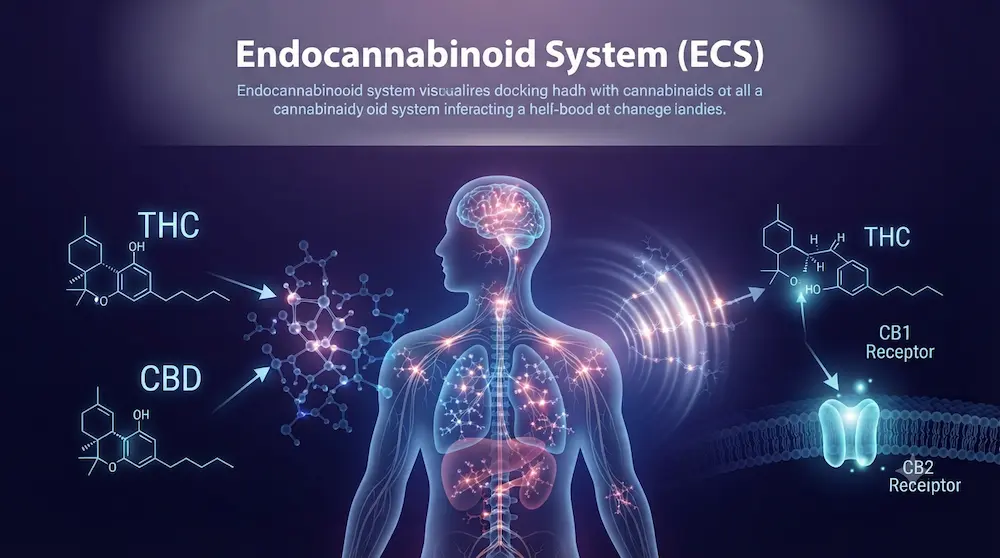
To understand how cannabis affects the human body, you first have to understand the Endocannabinoid System (ECS). Discovered by researchers in the late 1980s and early 1990s while studying how THC interacts with the brain, the ECS is a vast cell-signaling network found in all mammals.
The primary function of the ECS is to maintain homeostasis—meaning it helps regulate and balance critical bodily functions, including:
- Mood and emotional processing
- Sleep cycles and circadian rhythms
- Pain perception and inflammatory responses
- Appetite, metabolism, and digestion
- Immune function and memory
The ECS consists of three core components:
- Endocannabinoids: Molecules naturally produced by your body (such as anandamide and 2-AG) that bind to receptors to signal when something needs adjustment.
- Receptors: Primarily CB1 receptors (abundant in the central nervous system and brain) and CB2 receptors (found largely in the peripheral nervous system and immune cells).
- Enzymes: Specialized proteins responsible for breaking down endocannabinoids once they have finished carrying out their job.
Plant-derived cannabinoids (known as phytocannabinoids) like THC and CBD are structurally similar enough to your body's natural endocannabinoids that they can interact with these exact same receptors, unlocking various physiological responses.
The Major Players: THC vs. CBD
While the cannabis plant houses over a hundred distinct cannabinoids, two primary compounds dominate the conversation and research:
Delta-9-Tetrahydrocannabinol (THC)
THC is the most well-known phytocannabinoid and is primarily responsible for the intoxicating "high" associated with cannabis.
- How it Works: THC binds strongly and directly to CB1 receptors in the brain, triggering a cascade of neural activity that alters perception, mood, appetite, and sensory experiences.
- Potential Benefits: Beyond euphoria, clinical research suggests THC can be a powerful tool for managing chronic pain, stimulating appetite in medical patients, reducing muscle spasticity, and promoting deep sleep.
Cannabidiol (CBD)
Unlike THC, CBD is entirely non-intoxicating—meaning it will not make you feel high, making it a favorite for wellness consumers seeking therapeutic relief without cognitive impairment.
- How it Works: CBD has a low affinity for direct binding to CB1 and CB2 receptors. Instead, it acts as an indirect modulator, influencing other receptor systems in the body (like serotonin and vanilloid receptors) and encouraging the body to use more of its own natural endocannabinoids.
- Potential Benefits: CBD is widely studied for its anxiolytic (anti-anxiety) properties, anti-inflammatory effects, neuroprotective benefits, and its proven efficacy in treating rare forms of childhood epilepsy (such as Epidiolex).
The Entourage Effect: Why Whole-Plant Synergy Matters
For years, modern pharmacology focused heavily on isolating single compounds (like synthetic THC pills). However, users and researchers quickly realized that isolated compounds rarely work as effectively as whole-plant extracts.
This phenomenon is known as the Entourage Effect. Coined by renowned researchers Raphael Mechoulam and Shimon Ben-Shabat, the theory suggests that phytocannabinoids, minor cannabinoids (like CBG, CBN, and CBC), and aromatic plant compounds called terpenes work synergistically together.
For example, research indicates that CBD can actually temper some of the unwanted side effects of THC—such as acute anxiety or paranoia—when they are consumed together in balanced ratios. Similarly, specific terpenes (like myrcene or limonene) not only provide distinct flavors and smells but actively influence how cannabinoids cross the blood-brain barrier and bind to receptors.