How a Single Federal Farm Law Unlocked Nationwide Cannabis Seed Shipping
In every corner of the United States—including states where recreational cannabis remains strictly illegal—a quiet revolution has taken place. Discrete padded envelopes carrying seeds from world-class cannabis strains land in suburban mailboxes every single day.
To the uninitiated, this looks like a massive, illicit underground network Operating in plain sight. In reality, it is a multi-million-dollar industry anchored entirely in federal law.
If you have ever searched "are cannabis seeds legal to buy online in the US?", you have stumbled onto one of the most fascinating legal loopholes in modern American history. The legal mechanism that makes this possible traces back to a landmark piece of agricultural legislation and a historic clarification from the Drug Enforcement Administration (DEA).
This is the breakdown of how cannabis seed banks leverage the 2018 Farm Bill, why the DEA confirmed their legality, and what you must know before placing an order.
The Legal Framework: The 2018 Farm Bill
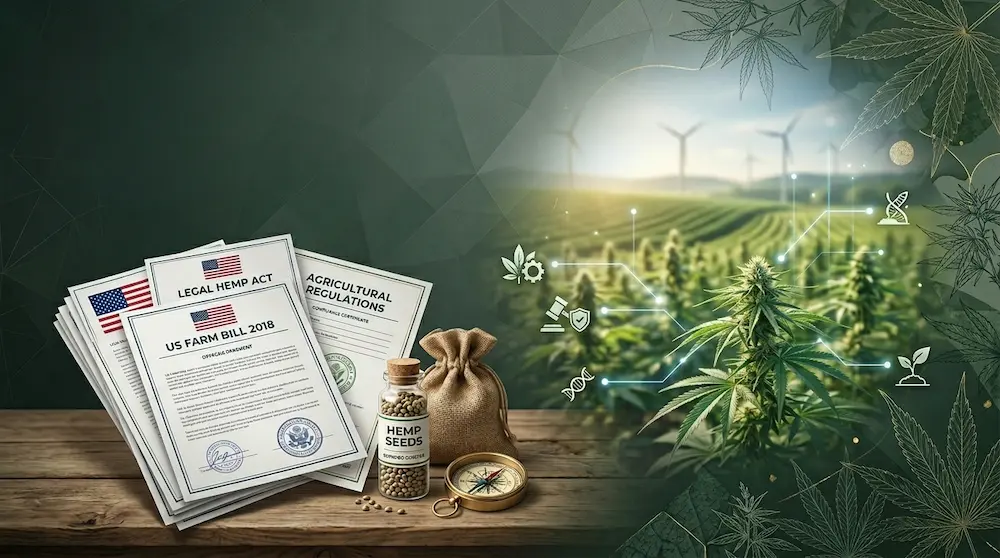
To understand why seed banks can ship freely across state lines, you first have to look at the law that accidentally blew the doors wide open: the Agriculture Improvement Act of 2018 (commonly known as the 2018 Farm Bill).
The Line Between "Marijuana" and "Hemp"
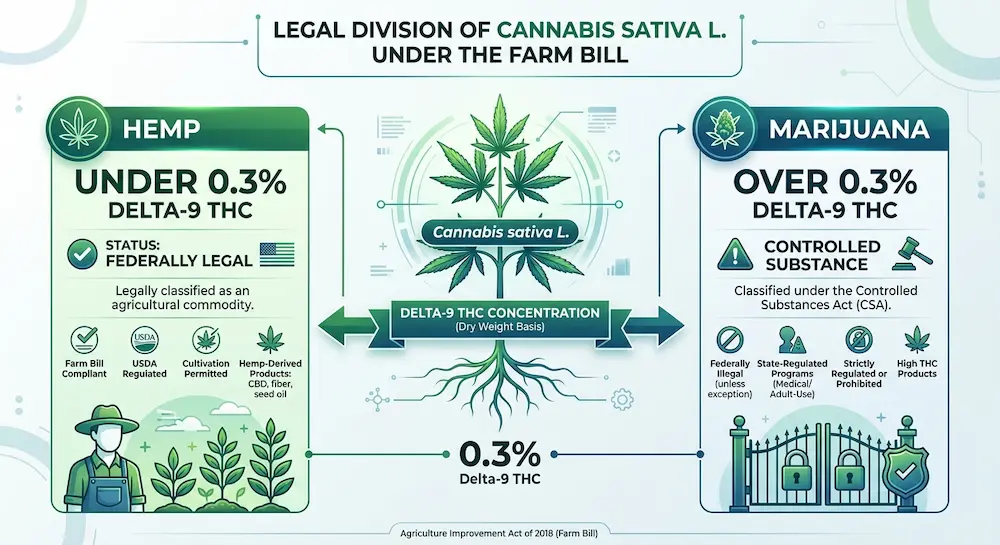
Before December 2018, all Cannabis sativa L. plants and plant parts were classified as Schedule I Controlled Substances under federal law. The 2018 Farm Bill changed this by establishing a clear legal distinction based on a single chemical compound: Delta-9 Tetrahydrocannabinol (Delta-9 THC).
Under the Farm Bill:
- Hemp: Defined as any part of the Cannabis sativa L. plant—including the seeds thereof and all derivatives, extracts, and cannabinoids—containing not more than 0.3% Delta-9 THC on a dry weight basis. Hemp was officially removed from the Controlled Substances Act (CSA).
- Marijuana: Any cannabis material containing more than 0.3% Delta-9 THC. This remains federally illegal.
By explicitly legalizing "all derivatives, extracts, cannabinoids, isomers, acids, salts, and seeds thereof" under the 0.3% threshold, Congress unintentionally created a massive opening for seed retailers.
The Science of the Seed: Why Seeds Contain Zero THC
The reason cannabis seeds comfortably clear the Farm Bill’s threshold comes down to plant biology.
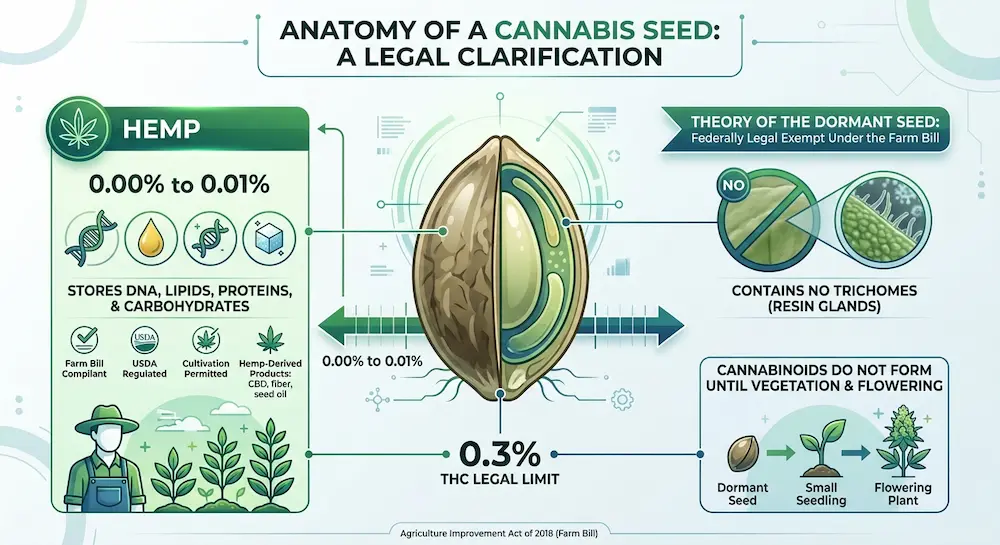
Cannabinoids like Delta-9 THC and its precursor THCA are produced inside glandular trichomes—the tiny, crystal-like resin structures that coat the flowers (buds) and sugar leaves of mature female plants.
A cannabis seed:
- Contains embryonic plant tissue, fats, proteins, and genetic blueprints.
- Does not possess trichomes.
- Has virtually 0.00% active Delta-9 THC (rarely exceeding trace levels of 0.01%).
Whether a seed contains the genetics for an industrial fiber hemp plant or an award-winning strain with 30% THC potency, the seed itself contains almost no THC.
Because federal law tests the material in hand rather than what it might become, a high-potency cannabis seed meets the exact chemical definition of industrial hemp.
The Turning Point: The DEA’s Official Stance
For a few years following the 2018 Farm Bill, operators in the cannabis space proceeded with caution, wondering if federal law enforcement would argue that seeds from "marijuana" plants were inherently illicit.
That debate ended in early 2022.
The 2022 DEA Letter
In late 2021, cannabis attorney Shane Pennington formally asked the DEA to clarify its stance on cannabis seeds, tissue cultures, and other genetic materials.
On January 6, 2022, Dr. Terrence L. Boos, Chief of the DEA’s Drug & Chemical Section, issued an official response letter that reshaped the industry:
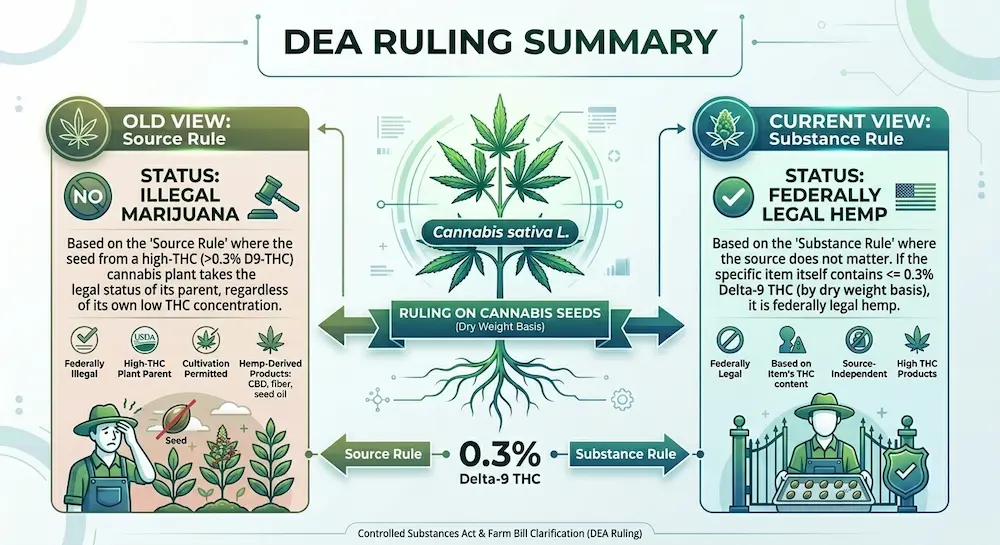
The DEA effectively killed the "Source Rule". It affirmed that the federal government judges an item based strictly on its own chemical composition at the time of inspection—not the genetic heritage of the mother plant or the potential concentration of the full-grown crop.
The E-Commerce Explosion: How Seed Shipping Took Off
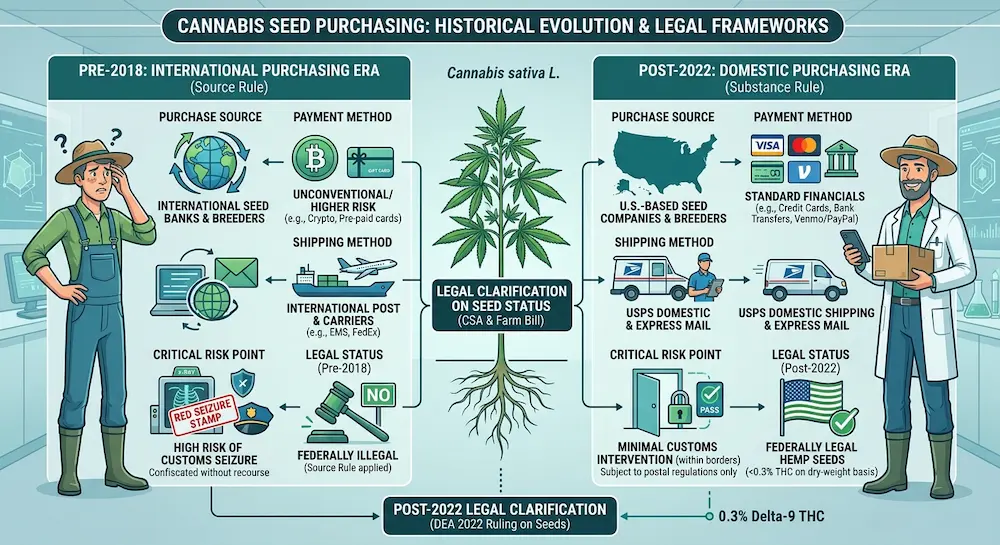
The DEA’s letter gave domestic seed banks green-light confidence. Overnight, the market transformed from an offshore, risky import model into a thriving domestic e-commerce industry.
Why USPS Ships Seeds
Because hemp products with 0.3% or less Delta-9 THC are federally legal, they fall within the allowable mailing rules of the United States Postal Service (USPS). Under USPS Publication 52 (Hazardous, Restricted, and Perishable Mail), domestic shipments of hemp and hemp-derived products are explicitly mailable, provided they comply with federal hemp standards.
Consequently, using federal mail services to ship seeds across state lines is entirely permitted under federal policy.
The "Souvenir" Novelty Loophole
To protect themselves further against state-level regulations, most online seed banks sell seeds labeled as "novelty items," "souvenirs," or "collectible genetic preservation samples."
This marketing language serves a specific legal function:
- Selling and purchasing dormant seeds as collectibles remains federally protected as long as they contain less than 0.3% THC.
- Germinating the seed, however, initiates biological growth that will lead to a plant containing high levels of THC.
- By framing sales around genetic preservation, seed banks shift the responsibility for legal compliance during cultivation entirely onto the buyer.
Federal Law vs. State Law: Where the Line Gets Blurry
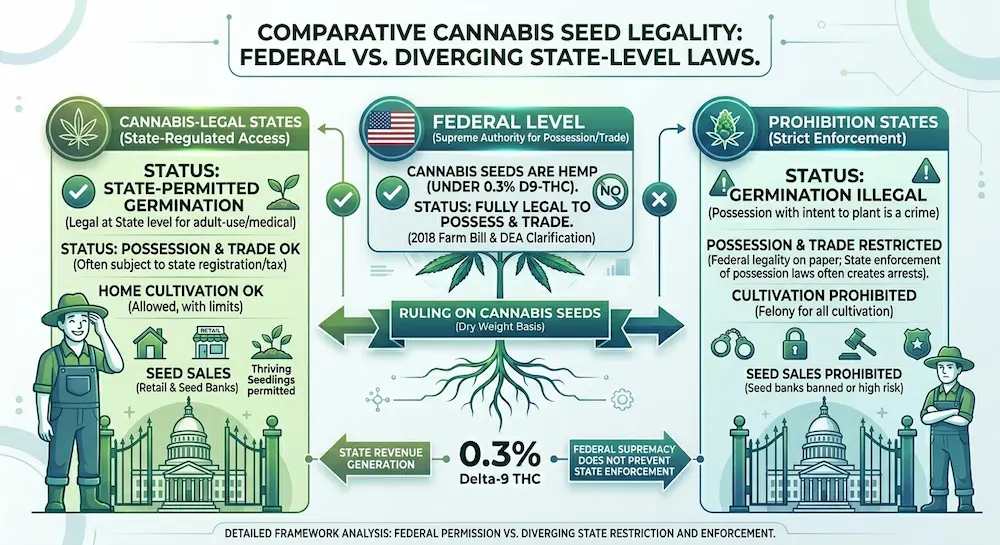
While buying cannabis seeds online is federally clear, local enforcement is governed by a patchwork of state laws.
State-Level Pitfalls
- Possession vs. Germination: Federal law protects the physical seed packet sitting on your counter. However, the moment you drop that seed into water or soil, you enter state jurisdiction. If you live in a state where home growing is illegal, germinating that seed transitions it into illegal manufacture of a controlled substance.
- State Hemp Definitions: Some states have updated their local statutes to restrict seed sales or require specific agricultural licenses to possess any cannabis genetics, creating potential friction with federal law.
Comparison: Seed Legality Breakdown
To summarize how different stages of the purchasing and growing process align legally across the US:
| Action / Material | Federal Status | State Status |
|---|---|---|
| Buying seeds online | Legal (Hemp exemption under 0.3% THC) | Generally allowed, though local statutes vary |
| Shipping via USPS | Fully Legal across all state borders | Subject to domestic postal guidelines |
| Possessing dormant seeds | Legal | Legal in most states; restricted in select non-friendly states |
| Germinating high-THC seeds | Illegal federally (if resulting plant > 0.3% total THC) | Legal only in states with home-cultivation laws |
What Buyers Need to Know Before Ordering
If you are considering ordering cannabis seeds online in the US, keep these essential steps in mind:
- Know Your State’s Cultivation Rules: Buying the seed is the easy part. Before attempting to germinate, check whether your state allows home cultivation, how many plants you are permitted to grow, and whether you need a medical card or license.
- Buy Domestic for Speed and Safety: Importing seeds internationally means dealing with U.S. Customs and Border Protection, where shipments can still be seized or delayed. Domestic US seed banks ship via USPS without international customs friction.
- Choose Reputable US Breeders and Banks: Look for established companies that provide full transparency, lab reports (COAs) verifying compliant THC levels in their batch testing, and clear customer service policies.
- Understand the Risk Boundaries: Until full federal legalization occurs, the gap between federal definitions and state-level enforcement remains complex. Treat seed purchases responsibly and stay informed on changing legislation.
Final Thoughts
The explosion of online cannabis seed sales in the United States isn't an enforcement failure; it is the direct outcome of federal statutory drafting. By establishing a strict 0.3% Delta-9 THC threshold, the 2018 Farm Bill reclassified cannabis seeds as legal hemp—a reading confirmed by the DEA.
While state-level laws govern what you can actually do with those seeds, federal law ensures that purchasing genetic souvenirs online is legal across the United States.
Disclaimer: This article is intended for informational and educational purposes only and does not constitute legal advice. Always check your local, state, and federal laws regarding cannabis possession, seed purchasing, and cultivation.