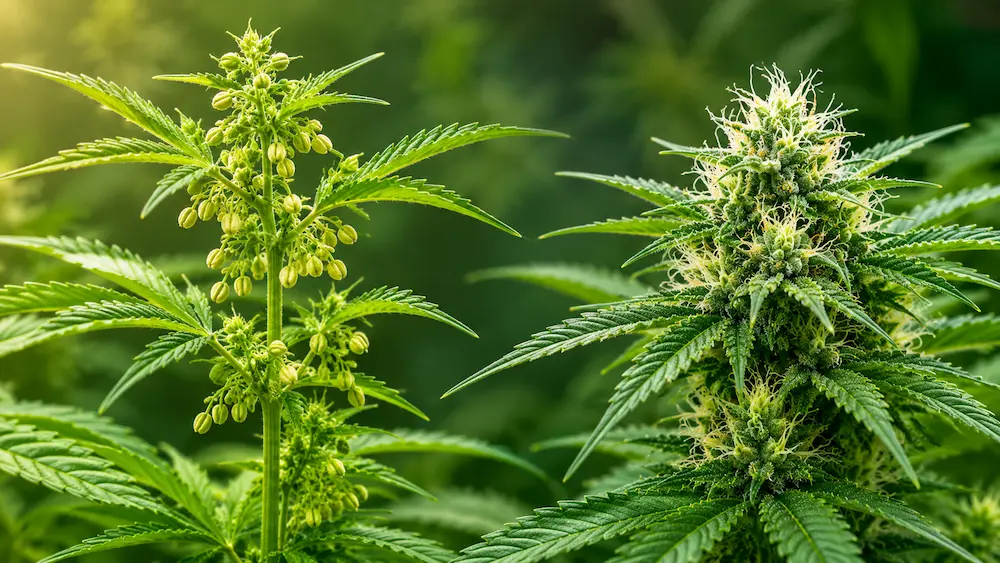

Cannabis is one of the few crops where the sex of the plant changes everything: what it grows, what it's used for, and whether it helps or ruins a harvest. If you've ever wondered about the difference between male and female cannabis plants, you're asking one of the most important questions in cannabis botany.
In this guide, we break down the difference between male and female cannabis plants in plain English: the genetics behind it, how to tell them apart, why it matters, and what's new in the science.
Quick answer: Female cannabis plants grow the resin-covered flowers (buds) that contain most of the cannabinoids and terpenes people value. Male plants grow small pollen sacs, produce little useful resin, and exist to fertilize females. Some plants are hermaphrodites and grow both.
Why Cannabis Has Male and Female Plants
Cannabis sativa is dioecious, which means male and female reproductive organs normally grow on separate plants. Dioecy is actually uncommon in the plant world: it's found in only around 6% of flowering plant species, and researchers think it evolved from hermaphroditic ancestors.
Because the two sexes live on different plants, cannabis is an obligate outcrosser. Pollen has to travel from a male to a female for seeds to form. That's good for genetic diversity in nature, but it creates a big problem for anyone growing the plant for its flowers, as we'll see below.
The Genetics Behind the Difference Between Male and Female Cannabis Plants
Sex in cannabis is set at the chromosome level, much like in humans:
- Female plants carry two X chromosomes (XX).
- Male plants carry one X and one Y chromosome (XY).
Cannabis has 20 chromosomes in total: nine pairs of autosomes plus the sex chromosome pair. The Y chromosome is larger than the autosomes, which is why male plants have a slightly bigger genome than females (roughly 843 vs 818 megabases in one widely cited estimate).
Sex determination in cannabis is still being worked out. A 2025–2026 preprint reported an ancient region of the X chromosome containing three candidate genes that may control both male-female and monoecious-dioecious sex expression. In other words, researchers are close to understanding why a seedling becomes male or female, but the picture isn't complete yet.
Environment matters too. Stress, such as light interruptions, heat, or damage, can push a plant to produce flowers of the opposite sex, so sex in cannabis is not purely fixed by chromosomes.
Male vs Female Cannabis Plants: Side-by-Side Comparison
| Feature | Male cannabis plants | Female cannabis plants |
|---|---|---|
| Chromosomes | XY | XX |
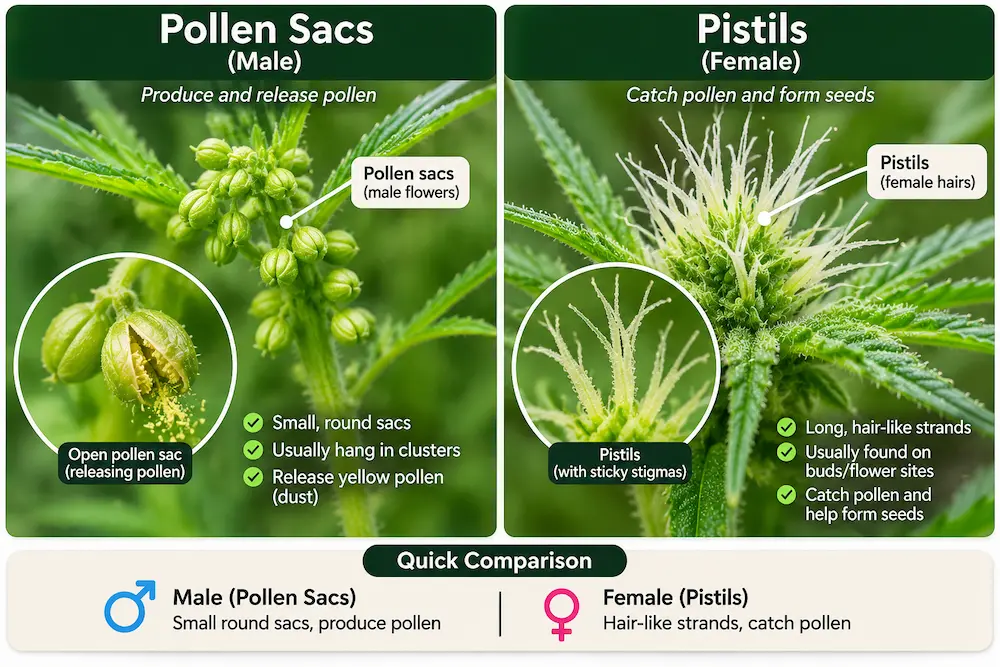
| Reproductive organs | Staminate flowers with pollen sacs (anthers) | Pistillate flowers with pistils and stigmas |
| Appearance of flowers | Small, round, grape-like clusters of sacs | Teardrop-shaped calyxes with white, hair-like pistils that form dense buds |
| Resin and trichomes | Few trichomes, little resin | Heavy trichome coverage, sticky resin |
| Cannabinoid content | Low (mostly in leaves) | High (concentrated in flowers) |
| Growth habit | Often taller, lankier, fewer leaves and branches | Often shorter and bushier |
| Flowering speed | Typically shows sex and matures earlier | Shows sex slightly later, flowers over a longer period |
| Main purpose | Pollination and breeding, fiber | Flowers for consumption, extracts, seed (when pollinated) |
| Seeds | Cannot produce seeds | Produce seeds only if pollinated |
Keep in mind that growth habit is only a rough guide. Genetics and strain vary hugely, so the flowers are the only truly reliable test.
How to Tell the Difference Between Male and Female Cannabis Plants
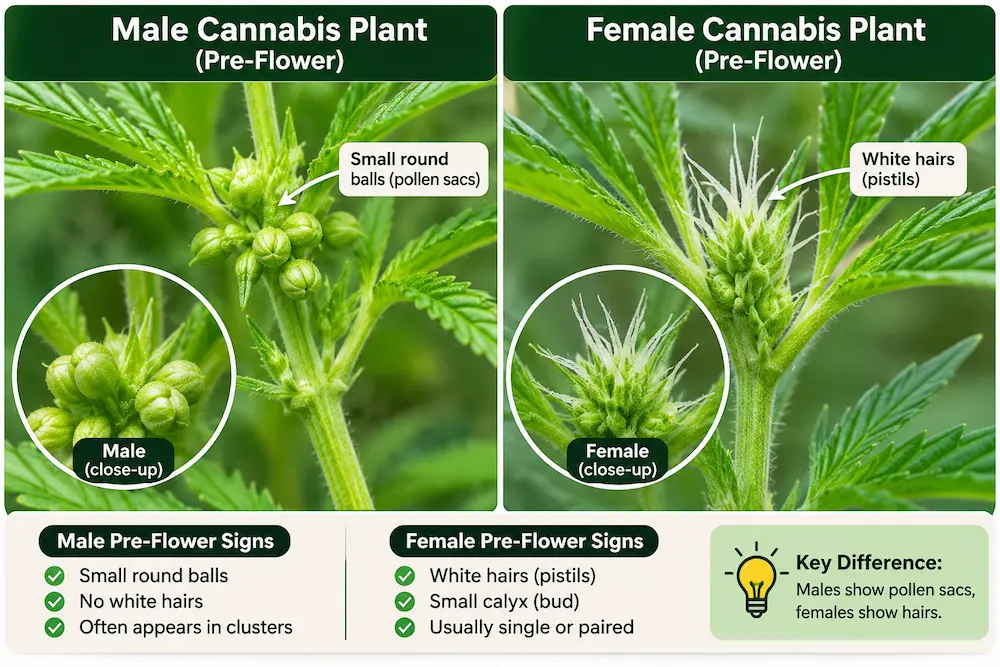
There are several ways to spot the difference between male and female cannabis plants, from early pre-flowers to full bloom.
1.Look at the pre-flowers
Before a plant starts flowering for real, it develops tiny pre-flowers at the nodes (the points where branches meet the main stem). This usually happens a few weeks after germination, often within the first month or two of vegetative growth.
- Male pre-flowers: small, rounded, ball-shaped pouches with no hairs. They often form in clusters and may look like tiny bananas or grapes as they develop.
- Female pre-flowers: a small, teardrop-shaped calyx with one or two thin white hairs (pistils) poking out.
A magnifying glass or jeweller's loupe makes this far easier.
2. Check the nodes during flowering
Once flowering begins, the difference is unmistakable. Males develop hanging clusters of pollen sacs that eventually open and release fine pollen. Females develop clusters of calyxes with pistils that thicken into buds, covered in glistening trichomes.
3. Watch the overall structure
Males often stretch faster, grow taller, and look sparser, with thicker stalks and fewer leaves. Females tend to be shorter, more branched, and leafier. Again, treat this as a hint rather than proof.
4. Use DNA testing
For commercial growers and breeders, genetic tests can determine a seedling's sex before any flowers appear. These tests look for DNA markers linked to the Y chromosome, and they are used when growers want to cull males very early.
5. Start from feminized seeds
Most modern growers avoid the guessing game altogether by using feminized seeds, which are produced so that nearly all the seedlings are female. (Autoflowering varieties are separate: they flower based on age rather than light cycle, and they also come in feminized form.)
Why the Difference Between Male and Female Cannabis Plants Matters
Seeds ruin the harvest
When a female plant is pollinated, it redirects energy from making resin and flower into producing seeds. The buds become seedy, harsher, and generally lower in quality. In commercial production, cultivators typically destroy male plants for exactly this reason. This is also why the term sinsemilla (Spanish for "without seeds") exists: it describes unpollinated female flowers.
One male can pollinate a lot of females
Pollen is light and can drift a long way on air currents. A single male can pollinate an entire crop of females, which is why growers, hemp farmers especially, pay close attention to this issue.
Genetics and breeding depend on males
Every new cannabis strain starts with pollen. Breeders select males carefully, often testing them by crossing them with identical female clones and comparing the offspring. A high-quality male brings half of a strain's genetics to the next generation, including potency, aroma, disease resistance and growth habit.
The Third Category: Hermaphrodite Cannabis Plants
Sometimes a plant doesn't stick to one sex. Hermaphrodite (or monoecious) cannabis plants produce both male and female flowers. There are two common scenarios:
- Stress-induced hermaphroditism: a genetically female plant grows male flower parts (often called "nanners" or bananas) in response to stress such as light leaks, heat, or physical damage. These plants can self-pollinate and fill buds with seeds.
- Monoecious cultivars: some hemp varieties have been deliberately bred to carry both flowers on the same plant. Research indicates these plants are typically XX genetically, and their sex expression has a genetic basis.
A 2020 study in Frontiers in Plant Science found that seeds from hermaphroditic flowers produced genetically female seedlings, while seeds from normal male-female crosses gave about a 1:1 ratio of males to females. This is the principle behind many feminized seeds, though breeders also use chemical treatments, such as silver thiosulfate, to induce male flowers on genetically female plants.
Are Male Cannabis Plants Useless? Not Quite
While females get most of the attention, male plants have real value:
- Breeding. Males supply the pollen needed to create new strains and keep genetic diversity healthy.
- Hemp fiber. Male hemp is often prized for softer, finer fiber, which suits textiles and household goods, while female plants tend to give coarser fiber.
- Cannabinoids, in small amounts. Male plants do contain some cannabinoids, mostly in the leaves rather than flowers. A frequently cited 1971 study found female plants generally had higher concentrations, though a few male samples were surprisingly high in certain cannabinoids. In practice, the amounts are low and males are rarely grown for this purpose.
- Garden and compost use. Once males are no longer needed, many growers compost them.
Common Myths About Male and Female Cannabis Plants
Myth: Male plants get you high. Males contain only minimal cannabinoids and produce little resin, so they're not considered worthwhile for consumption.
Myth: You can tell the sex from the seed. There's no reliable visual way to tell a male seed from a female one. Sex only becomes visible as the plant matures, or through DNA testing.
Myth: Only females have cannabinoids. Both sexes produce them, but females produce far more, concentrated in the flowers.
Myth: Hermaphrodites are always a grower's mistake. They can be caused by stress, but they can also be genetic, and some are deliberately bred for hemp production.
Related Articles: Top 10 cannabis myths, Top 10 cannabis facts
Key Takeaways
- The difference between male and female cannabis plants comes down to chromosomes (XY vs XX), reproductive organs, and purpose.
- Females produce the resinous buds; males produce pollen and little else of consumer value.
- Pre-flowers at the nodes are the earliest visual clue; DNA testing is the earliest reliable one.
- Hermaphrodites carry both flower types and can pollinate themselves.
- Hermaphrodites carry both flower types and can pollinate themselves.
- Science is still uncovering the genes that control sex in cannabis.
This article is for educational purposes only and isn't legal or medical advice.