

Autoflower vs. Fast Cannabis Strains: Key Differences Explained
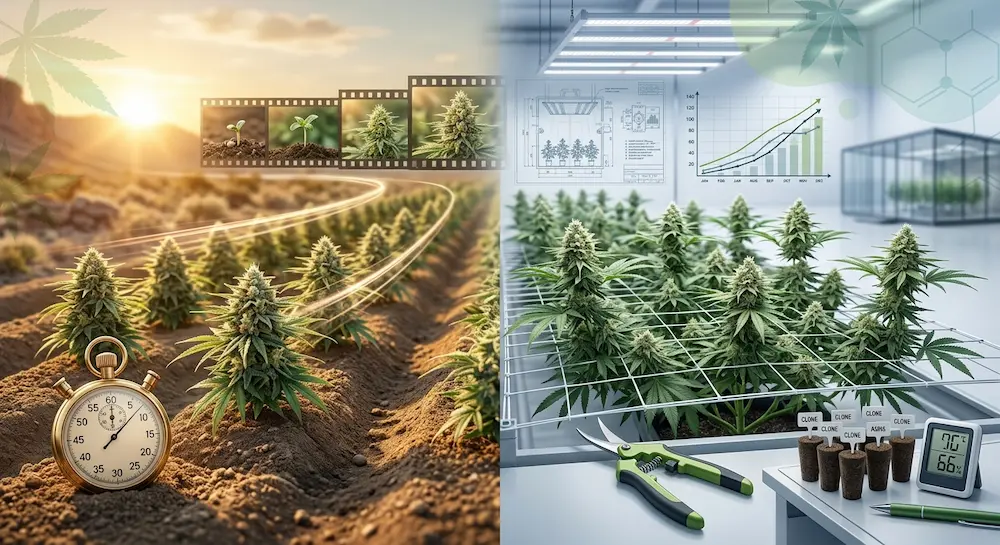
For growers looking to speed up their harvest without sacrificing quality, the cannabis seed market offers two primary options: Autoflowering strains and Fast (or Fast-Version) photoperiod strains.
While both promise quick results and resilience against bad weather, they operate under entirely different genetic rules. Choosing the wrong one for your climate, space, or skill level can mean the difference between a bumper harvest and stunted plants.
This comprehensive guide breaks down the core differences, genetics, pros, cons, and cultivation practices of Autoflower vs. Fast cannabis strains.
Defining the Genetics
What Are Autoflower Strains?
Autoflowering cannabis strains contain genetics from Cannabis ruderalis—a wild subspecies native to cold regions like Siberia and Central Europe. Because natural sunlight in these northern latitudes is brief, ruderalis adapted to flower based on age rather than changes in daylight hours.
- Light Sensitivity: Photoperiod-insensitive.
- Life Cycle: Transitions automatically from seed to flower in 3 to 4 weeks, completing its full lifecycle in 8 to 11 weeks total.
Browse ILGM's top-rated Autoflowering Seeds for fast, hassle-free growing.
What Are Fast (Fast Version) Strains?
Fast strains (often labeled as Fast Version, F1 Fast, or Early Version) are photoperiod-sensitive strains. They are typically created by crossing an elite photoperiod strain with an autoflowering strain.
The resulting F1 offspring retains photoperiod behavior (meaning it requires a 12/12 light schedule to flower indoors), but flowers significantly faster than regular photoperiods—often knocking 1 to 3 weeks off the flowering phase.
- Light Sensitivity: Photoperiod-dependent (requires short days/long nights to bloom).
- Flowering Duration: Typically finishes blooming in 6 to 7 weeks after switching the light schedule.
Check out ILGM's Fast Version Feminized Strains for quick photoperiod yields.
Key Differences: Autoflower vs. Fast Strains
Understanding how these two categories compare side-by-side helps determine which best suits your setup.
| Feature | Autoflower Strains | Fast Version Strains |
|---|---|---|
| Flowering Trigger | Age-based (automatic) | Light schedule change (12/12) |
| Seed-to-Harvest Time | 8 – 11 weeks total | 6 – 7 weeks flowering phase + veg time |
| Vegetative Phase Control | None (fixed by nature) | Complete control (extend or shorten veg) |
| Cloning & Propagation | Not recommended | Yes (full photoperiod cloning) |
| Plant Size | Compact to medium (2 – 4 ft) | Medium to large (flexible based on veg) |
| High-Stress Training (HST) | High risk of stunting | Fully supported (topping, mainlining) |
| Indoor Light Schedule | 18/6 or 20/4 all cycle | 18/6 (veg) then 12/12 (bloom) |
Comparing Timelines: Understanding "Fast"
A common mistake among growers is misinterpreting seed catalog timelines.
- Autoflower timeline listings represent the entire life cycle (e.g., "10 weeks from seed to harvest").
- Fast strain timeline listings represent only the flowering stage (e.g., "6 weeks flowering").
To calculate total time for a Fast strain indoors, add your desired vegetative growth period (usually 3–5 weeks) to the 6–7 week flowering time.
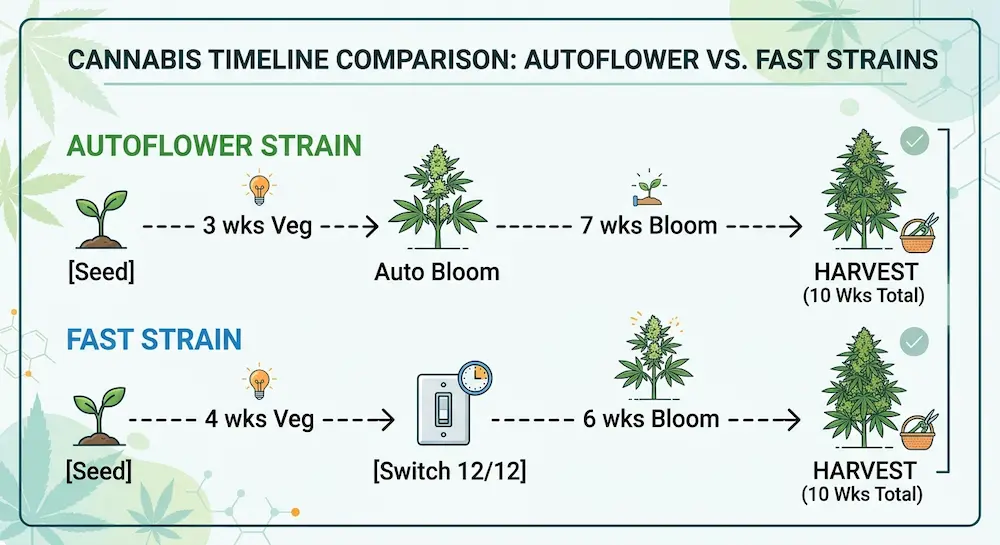
The Advantage: With a Fast strain, the length of the vegetative phase remains in the grower's hands. If plants suffer from nutrient burn, pest damage, or need extensive training, the vegetative phase can be extended until recovery before flipping to bloom. With an autoflower, the plant will flower on schedule regardless of its health.
Indoor Cultivation: Which Is Best?
Choose Autoflowers Indoors If:
- Space is Limited: Compact structures fit easily in small tents or closets.
- Simplified Light Timing: No need for light-proof seals or timers switching between 18/6 and 12/12.
- Perpetual Harvests in One Tent: Seedlings, vegetative plants, and flowering plants can all share a single tent under an 18/6 light schedule.
Choose Fast Strains Indoors If:
- Maximizing Yields via Training: Fast strains accept topping, FIMing, and super-cropping.
- Saving Electricity Costs: Flipping to 12/12 light during bloom consumes less electricity per day than running an autoflower under 20/4 or 18/6 light during its bloom stage.
- Cloning Potential: Superior plants can be kept as mother plants to produce genetically identical clones indefinitely.
Explore ILGM's complete Indoor Grow Kits paired with high-yield seeds.
Read Our Comprehensive Indoor Cannabis Grow Guide
Outdoor Cultivation: Climate & Latitude Considerations

Outdoor growing highlights the distinct practical advantages of both options.
The Outdoor Fast Version Strategy
In northern regions or cold climates, autumn rains and frost arrive early in October, bringing mold, mildew, and bud rot. Standard photoperiod strains often flower late into October or November, creating high crop risks.
Fast strains solve this problem: They trigger early and finish blooming by mid-to-late September, allowing harvest before bad weather arrives, while producing yield potential comparable to full photoperiod plants.
The Outdoor Autoflower Strategy
Autoflowers ignore day length completely. As long as temps remain above freezing, they can be planted in late spring and harvested by mid-summer. Growers in warm climates can run 2 to 3 successive outdoor harvests in a single season.
Read Our Comprehensive Outdoor Cannabis Grow Guide
Training, Yields, and Potency
Training Techniques
- Autoflowers: Low-Stress Training (LST) and gentle leaf tucking work best. High-Stress Training (HST) should generally be avoided because recovery time eats directly into the fixed growth timeline.
- Fast Strains: Perform like classic photoperiods. Mainlining, ScrOG (Screen of Green), topping, and heavy pruning can be used freely during veg.
Read a Detailed Guide on Low Stress Training
Yield Potential
- Autoflowers: Yields range from 1.5 to 4 oz (45–110g) per plant indoors, depending on light intensity and pot size.
- Fast Strains: Yield potential is significantly higher because plant size can be scaled during vegetative growth. Indoor yields often reach 16 to 21 oz/m² (450–600g/m²).
Potency & Cannabinoid Profiles
Modern breeding has closed the historical potency gap. Modern Autoflowers and Fast Versions consistently test between 20% and 26% THC when grown under optimal conditions.
Browse ILGM's highest THC seed varieties available now.
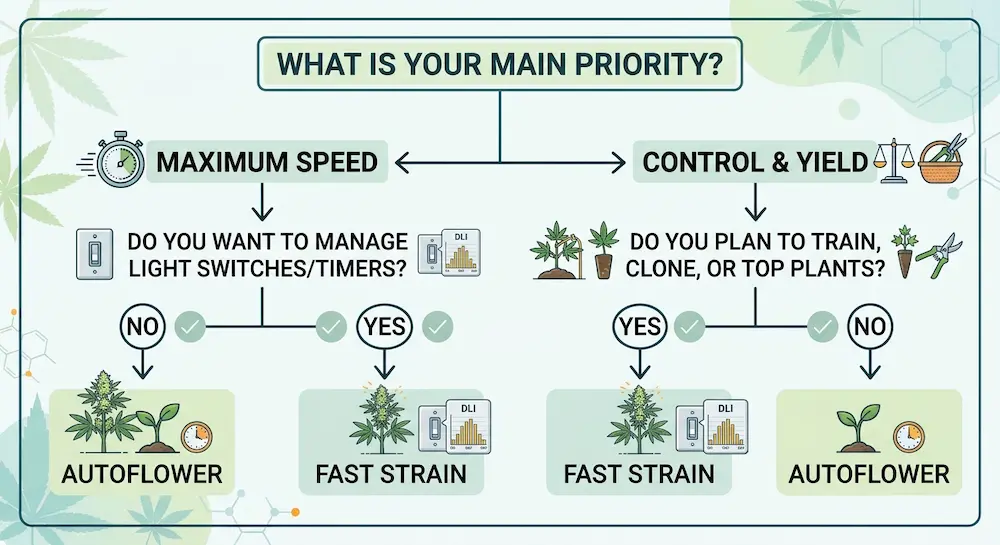
Decision Matrix: Which Should You Grow?
Final Verdict
- Choose Autoflowers if: Quick turnarounds, small spaces, minimal technical setup, or multiple summer outdoor harvests are the primary goals.
- Choose Fast Strains if: Short outdoor seasons demand a early autumn finish, plant size needs to be controlled via training, or cloning and maximum yields are desired.
Both options offer fast-track pathways to high-quality harvests without compromising potency or flavor.
Ready to start growing? Visit ILGM to explore Buy-1-Get-1-Free seed deals and strain mix packs.