
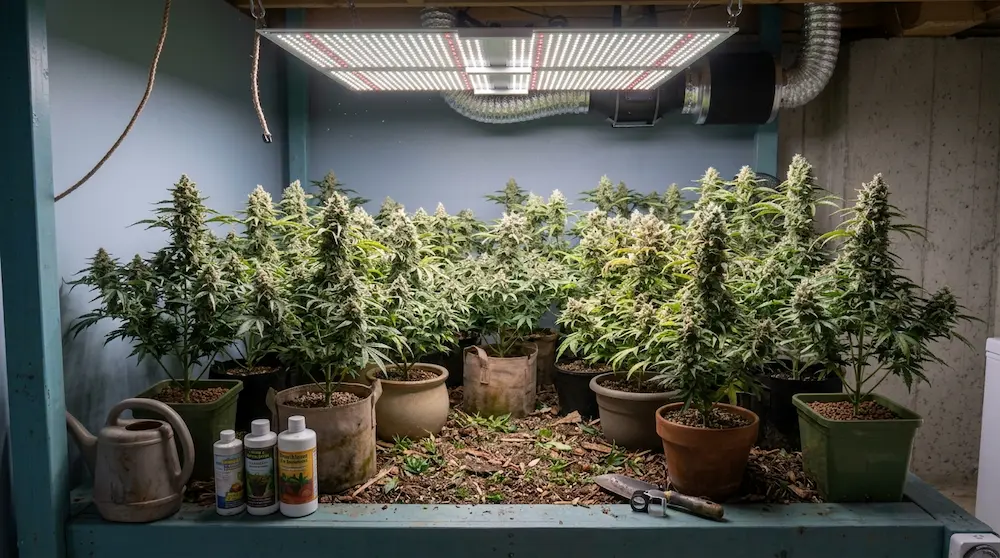

What Is Sea of Green (SOG) and How Does It Work?
When space and time are your biggest constraints, conventional indoor growing methods can feel painfully slow. Spending 6 to 8 weeks training a few large plants to cover a footprint requires significant vegetative energy, light output, and daily maintenance.
The Sea of Green (SOG) technique flips traditional cultivation logic on its head. Instead of investing months into developing a few sprawling bushes, SOG utilizes a high density of small plants packed tightly together. By triggering the flowering cycle after just a brief vegetative period, SOG turns your grow space into a thick, uniform canopy dominated by heavy main colas.
If your goal is achieving the maximum possible yields per square foot in the shortest time frame, this guide covers everything you need to execute a successful Sea of Green grow.
The Core Philosophy of Sea of Green
In nature, a cannabis plant naturally allocates its energy into a central leader surrounded by lower branches. In a standard indoor setup, those lower side branches often struggle to receive adequate PPFD (Photosynthetically Active Radiation) from overhead lighting, resulting in light, airy flower sites.
SOG solves this by treating your entire plant collection as a single collective canopy. Each individual plant is grown with minimal to no training, designed to produce one dominant central stem packed with top-shelf flower.
Why Commercial and Home Growers Choose SOG
- Accelerated Harvest Cycles: Because plants only spend 1 to 3 weeks in the vegetative stage before switching to a 12/12 light cycle, you can harvest up to 1 to 2 weeks faster per turn.
- Maximum Light Utilization: A tightly packed canopy ensures that photons from your light fixtures hit photosynthetic foliage rather than bouncing off open floor space.
- Ideal for Vertical Headroom Restrictions: SOG plants stay compact—typically finishing around 12 to 20 inches (30 to 50 cm) tall. This makes the technique ideal for low-clearance tents, shelving systems, or multi-tier racks.
- Simplified Canopy Management: Unlike Screen of Green (ScrOG) or mainlining, SOG requires virtually no topping, weaving, or complex tie-downs.
Essential SOG Gear and Planning Specifications
Because you are managing a high volume of plants in close quarters, selecting the correct container size and irrigation setup is vital.
| Component | Recommended Specification | Purpose |
|---|---|---|
| Containers | 1 to 3-gallon (4 to 11 L) fabric or plastic pots | Restricts excess vegetative growth while providing adequate root volume for single-cola development. |
| Plant Spacing | 1 to 2 sq ft per plant (approx. 4 to 9 plants per 3×3 ft tent) | Balances canopy density with necessary airflow and manual access. |
| Lighting | LED bar lights with uniform edge-to-edge spread | Eliminates hot spots and ensures identical light intensity across all plant tips. |
| Irrigation | Automatic drip line system or extended-reach watering wand | Simplifies feeding plants located toward the rear of a dense canopy. |
| Air Circulation | Dual oscillating fans (one above, one under canopy) | Prevents moisture accumulation and stagnant microclimates within packed foliage. |
Step-by-Step SOG Execution
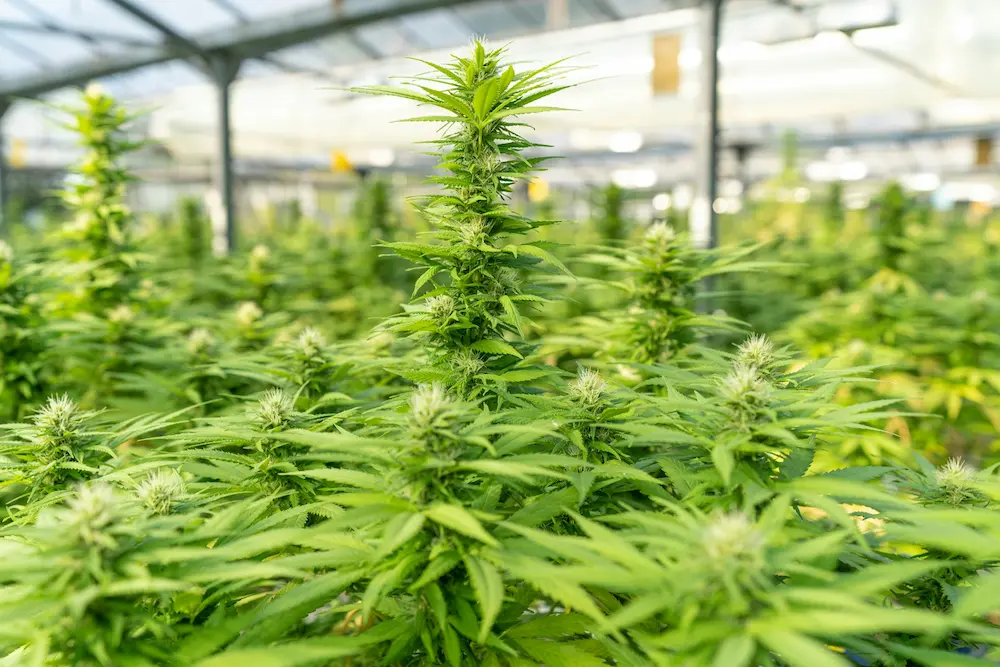
Executing a Sea of Green setup relies on consistency. If growth varies significantly between individual plants, taller specimens will shade out shorter ones, ruining canopy uniformity.
Step 1: Select and Propagate Uniform Genetics
Starting with genetically identical clones cut from a single mother plant is the gold standard for SOG setups. Clones share the exact same growth rate, node spacing, and flowering timeline. If you must grow from seed, select stable, feminized Indica-dominant strains known for low lateral stretching and rapid flowering.
Step 2: Establish the Root System (Veg Week 1–2)
Once your cuttings have established strong roots, transfer them into their final small containers. Keep lighting on an 18/6 schedule. Allow the plants to establish themselves until they reach roughly 8 to 12 inches (20 to 30 cm) in height.
Step 3: Trigger the 12/12 Flowering Cycle Early
Do not wait for the plants to bush out. Once plants show healthy new vegetative growth and fill out their small containers, flip your lighting cycle to 12 hours of light and 12 hours of darkness.
Step 4: Manage the Flowering Stretch
During the first 2 to 3 weeks of flowering, plants undergo a natural stretch. Keep your light fixtures at a consistent distance to prevent plants from reaching too tall and thin. If an individual plant stretches faster than its neighbors, rotate its pot to a peripheral spot or gently adjust its position to maintain a flat canopy profile.
Step 5: Perform Selective Defoliation and Pruning
Because SOG plants sit close together, lower leaves receive virtually no light once the canopy closes. Around week 2 or 3 of flowering, prune away shaded lower branches and fan leaves. This directs plant energy toward the main upper flower while dramatically improving airflow beneath the canopy.
Sea of Green (SOG) vs. Screen of Green (ScrOG)
While both techniques aim for an even canopy, their execution strategies represent completely different philosophies:
- Plant Count: SOG uses a high density of small plants (9 to 16+ per square meter), whereas ScrOG relies on a few large plants (1 to 4 per square meter).
- Vegetative Time: SOG vegetates for just 1 to 3 weeks, while ScrOG requires 4 to 8 weeks to train branches under a trellis net.
- Plant Training: SOG requires almost no training or topping, letting plants develop their natural single-cola shape. ScrOG relies on topping, low-stress training (LST), and horizontal branch weaving.
- Strain Flexibility: SOG works best with uniform clones of a single strain. ScrOG can accommodate multiple strains or stretchy Sativas, as the screen forces uneven growers into a flat plane.
Related Article: Screen of Green Guide
Potential Pitfalls in SOG Cultivation
- Overcrowding & Humidity Microclimates: Packing plants tightly creates high transpiration rates. Without proper intake fans, exhaust systems, and dehumidification, dense SOG setups become prime environments for Powdery Mildew and Botrytis (bud rot).
- Irrigation Logistics: Reaching containers in the center or back of a packed grow tent can be challenging. Installing automated drip lines or using an extended watering wand prevents neglected, underwatered pots.
- Plant Limit Regulations: In jurisdictions with strict per-person or per-household plant count limits, SOG may not be legal or practical due to its reliance on higher plant counts. Always check local regulations before planning a high-density grow.
- Mixing Strains with Different Growth Rates: Growing different strains together in a SOG setup often leads to uneven light distribution, as tall, fast-growing plants shadow slower, compact varieties.
Optimization Strategies for Maximum Efficiency
- Implement a Perpetual Harvest System: Dedicated SOG growers often maintain two separate spaces: a small vegetative area for mother plants and rooting cuttings, and a dedicated 12/12 bloom chamber. The moment one SOG batch is harvested, rooted clones move into the bloom space immediately, yielding continuous harvests every 8 to 9 weeks.
- Choose Short-Flowering Strains: Combine the short vegetative phase of SOG with fast-flowering photoperiod strains (60 days or less) to maximize crop cycles per year.
- Substrate Considerations: Using fast-draining substrates like coco coir paired with automated high-frequency fertigation allows small containers to support large, dense colas without root exhaustion.
Final Thoughts
The Sea of Green method remains one of the most efficient techniques in cannabis cultivation. By focusing your energy on fast turnarounds, uniform canopies, and single-cola production, SOG delivers high-yield harvests with minimal downtime.