State vs. Federal Rules: Navigating Airport Security with Legal Edibles
Every year, tens of millions of Americans walk through airport security carrying wellness gummies, tinctures, or low-dose edible chews tucked into their carry-on bags. For many travelers, a hemp-derived CBD or Delta-9 THC gummy is a non-negotiable remedy for pre-flight anxiety, long-haul back pain, or mid-flight sleep support.
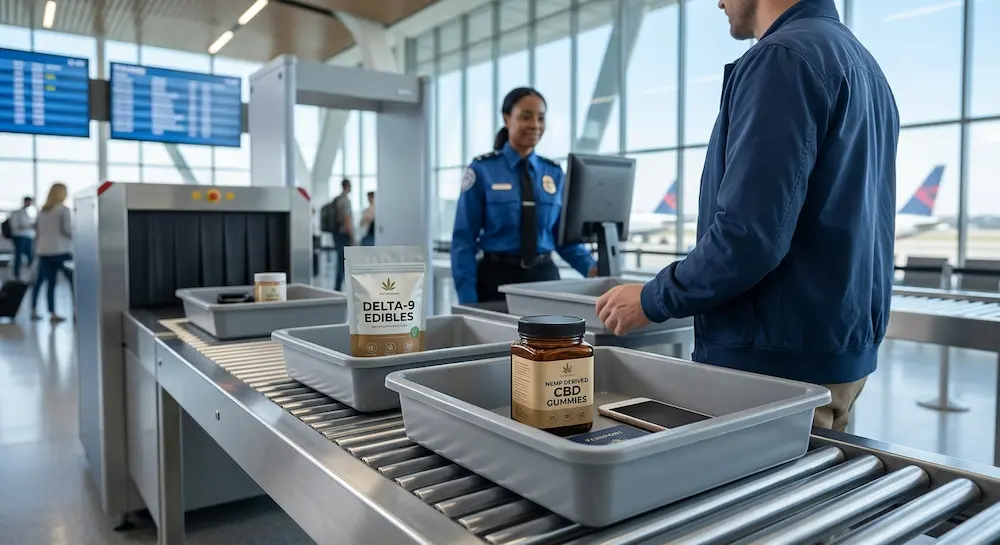
Yet, as you step into the Transportation Security Administration (TSA) screening line and lay your personal items into the plastic bin, a wave of hesitation often hits: Is carrying this gummy actually legal, or am I accidentally committing a federal crime?
The confusion is completely understandable. We live in a bizarre legal landscape where state-level dispensary laws, federal agricultural statutes, and airport security protocols create a maze of seemingly contradictory rules. Headlines claiming shifting TSA guidelines, statutory changes in federal hemp definitions, and ongoing discussions surrounding cannabis rescheduling only add fuel to the fire.
Here is what federal regulations, TSA protocols, legal boundaries, and airport security reality checks actually say about flying with CBD and Delta-9 edibles in the United States.
Related Article: Why Cannabis Seed Banks Are Technically Legal Under the US Farm Bill
The Legal Foundation: Hemp vs. High-THC Marijuana
To understand what you can legally carry past security, you first have to understand the fundamental legal distinction established under federal law. The statutory line between a legal wellness product and an illegal narcotic doesn’t depend on how a gummy makes you feel—it depends almost entirely on source plant material and dry-weight math.
The 2018 Farm Bill & Dry-Weight Mathematics
The Agricultural Improvement Act of 2018 (the 2018 Farm Bill) federally legalized hemp and all hemp-derived extracts, isomers, and cannabinoids, provided the final product contains no more than 0.3% Delta-9 THC on a dry-weight basis.
This definition created what many call the "hemp edibles loop." Because gummies, chocolates, and baked goods are relatively heavy by dry weight, a single gummy weighing 5 grams (5,000 milligrams) can legally contain up to 15 milligrams of pure Delta-9 THC while staying well under the statutory 0.3% limit:
Comparing Product Legalities at a Glance
| Feature | Hemp-Derived CBD | Hemp-Derived Delta-9 Edibles | State Dispensary Marijuana Edibles |
|---|---|---|---|
| Federal Legal Status | Fully Legal | Federally Compliant (<= 0.3 Delta-9) | Federally Illegal (Schedule I / Controlled) |
| THC Concentration | Non-intoxicating (< 0.3%) | Intoxicating (<= 0.3% dry weight) | High Potency (> 0.3% total volume) |
| TSA Compliance | Allowed | Allowed | Prohibited |
| Purchase Source | Retail, Online, Smoke Shops | Online, Direct-to-Consumer | Licensed State Dispensaries |
While federal legislative updates continuously debate total THC caps and synthetic cannabinoid definitions, hemp-derived products meeting the <= 0.3% Delta-9 threshold remain federally distinct from state-regulated dispensary marijuana.
TSA Rules Unpacked: What Security Checkpoints Actually Search For
The most critical factor to grasp before heading to the airport is the mandate of the agency overseeing the checkpoint.
Official TSA Policy:"TSA’s screening procedures are focused on security and are designed to detect potential threats to aviation and passengers. Accordingly, TSA officers do not search for marijuana or other illegal drugs..."
What Happens at the X-Ray Scanner?
- Focus on Aviation Safety: TSA agents are trained to spot explosives, firearms, flammable liquids, weapons, and oversized liquids. They are not drug enforcement officers, nor do they carry field-testing kits at screening lanes.
- Visual Indistinguishability: To an X-ray scanner or a visual check, a hemp-derived Delta-9 edible, a CBD chew, and a standard Haribo gummy bear appear identical. They are simply organic food matter.
- The Referral Protocol: If a TSA officer discovers a substance they suspect exceeds federal limits, they do not make arrests or write citations. Instead, their mandate requires them to refer the matter to local airport law enforcement.
If you are flying out of an airport located in a state where cannabis is legalized (such as LAX in Los Angeles or JFK in New York), local police officers generally enforce local state law. In many legal states, possessing personal amounts of cannabis inside the airport terminal is not a state crime, though airport authorities may still require you to discard the item before boarding.
The Federal Jurisdiction Trap: Crossing State Lines
A frequent point of confusion among travelers is assuming that flying between two states with legal recreational cannabis (e.g., flying from Denver, Colorado, to Seattle, Washington) protects them from federal oversight.
Why Interstate Travel Changes the Risk Profile
- Airports Are Federal Infill: The moment you pass through security, you enter an area governed strictly by federal jurisdiction.
- Airspace Is Federal: Commercial air transport operates within federal airspace regulated by the Federal Aviation Administration (FAA).
- State Cards Don't Travel: A state-issued medical marijuana card or a state dispensary receipt provides zero protection under federal law. State licenses do not grant immunity when stepping onto federal property or boarding commercial aircraft.
Related Article: Find out what is CBD
Conversely, because hemp-derived CBD and hemp-derived Delta-9 edibles (<= 0.3% THC) are federally legal under the Farm Bill, they are protected under the Commerce Clause. This allows compliant hemp products to cross state borders lawfully on domestic flights.
Practical Travel Protocol: How to Pack Edibles Safely
If you decide to travel with federally compliant hemp-derived CBD or Delta-9 edibles, adopting a clear, transparent packing strategy helps ensure a smooth trip through security.
Essential Checklist for Flying With Hemp Edibles
-
Keep Items in Original Retail Packaging
- Never transfer gummies or chews into unlabelled plastic baggies or generic pill organizers. Original packaging clearly displaying hemp origin, "0.3% Delta-9 THC," and an ingredient list immediately clarifies what the item is.
-
Carry a Digital or Physical Certificate of Analysis (COA)
- Most reputable hemp manufacturers print a QR code on the back of their packaging linking directly to a batch-specific COA from an accredited third-party laboratory. Having this lab report downloaded on your phone proves the product's legal hemp compliance.
-
Pack in Carry-On Bags (Not Checked Luggage)
- Keeping edibles in your carry-on allows you to answer questions directly if your bag undergoes a routine physical inspection. Additionally, aircraft cargo holds undergo extreme temperature shifts that can melt soft gummies into a unidentifiable mass.
-
Mind the TSA 3-1-1 Liquid Rule
- If your preferred CBD or Delta-9 product comes in liquid form (such as a tincture, oil, or beverage add-in), it must adhere to TSA’s liquid restrictions: containers must be 3.4 ounces (100ml) or smaller, placed inside a single clear quart-sized bag.
Non-Negotiable Boundaries: When NOT to Fly With Edibles
While domestic flights with compliant hemp products are legal, there are clear scenarios where carrying edibles carries severe legal risk:
International Flights (Zero Tolerance)
Crossing international borders with any form of cannabis, CBD, or hemp product—regardless of origin or percentage—is strictly illegal under international customs laws. Nations like Japan, Singapore, and the UAE enforce strict zero-tolerance policies where carrying CBD products can lead to mandatory detention, steep fines, or imprisonment. Leave all edibles at home when traveling internationally.
Raw Hemp Flower
Even if raw flower is 100% legally hemp-derived and compliant under federal law, it looks, smells, and tests visually identical to high-THC marijuana. TSA officers and airport law enforcement cannot distinguish between hemp flower and illicit marijuana without specialized laboratory equipment, practically guaranteeing delays, confiscation, and law enforcement questioning.
Destination State Restrictions
While federal law protects interstate commerce for hemp, individual states retain the right to restrict total THC limits or ban specific converted cannabinoids (such as Delta-8 or synthetic derivatives). Before landing, ensure your destination state allows the specific cannabinoid you are carrying.
Summary Checklist for Travelers
Before heading to the airport, verify your items against this final travel readiness checklist:
- Product Origin: Is the product explicitly labeled as hemp-derived?
- THC Limit: Does the packaging verify <= 0.3% Delta-9 THC content?
- Packaging: Is the item in its original, sealed brand container?
- Documentation: Do you have access to a digital Certificate of Analysis (COA)?
- Destination: Is your flight domestic within the United States?
- Liquids: Are any tinctures or oils under the 3.4 oz (100ml) limit?
By sticking to federally compliant hemp products, maintaining original packaging, and understanding TSA's security-first mandate, you can travel confidently across the country without unnecessary stress.