
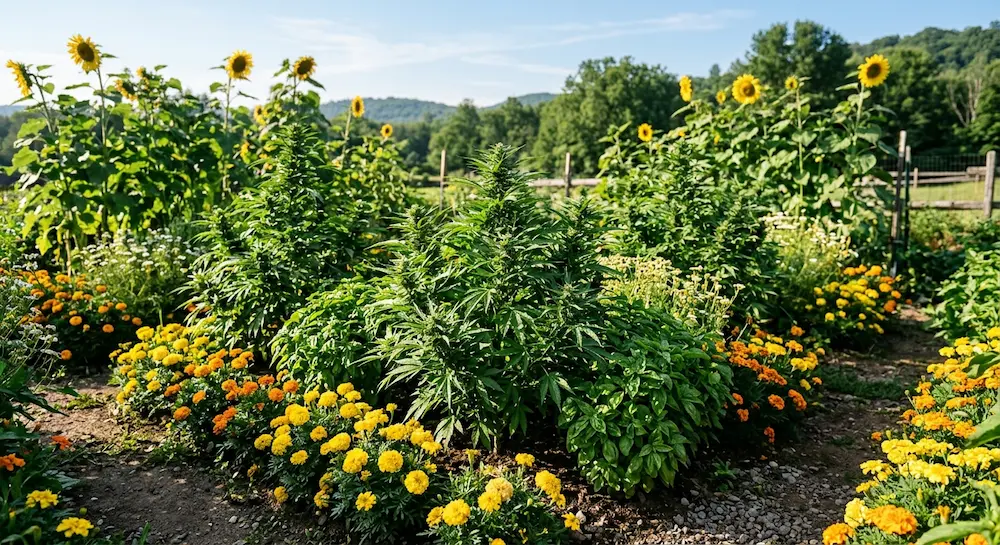

How to Protect Your Outdoor Crop from Pests and Prying Eyes—Naturally
Growing cannabis outdoors offers distinct advantages: natural sunlight, lower overhead costs, and rich soil microbiomes that enhance terpene profiles. However, outdoor cultivation presents two major challenges: pests and prying eyes.
Whether dealing with hungry spider mites or nosy neighbors, protecting your crop requires proactive management. While synthetic pesticides and tall fences are common solutions, thousands of growers turn to a natural, organic alternative: companion planting.
Integrating strategic botanical companions into your garden creates an ecosystem that repels harmful bugs, attracts beneficial predators, masks telltale skunk aromas, and offers natural camouflage.
What is Companion Planting?
Companion planting is the practice of growing mutually beneficial plant species close together. Rooted in traditional permaculture and polyculture farming, this technique leverages natural plant synergies to improve crop health and yield.
For outdoor cannabis growers, intercropping provides three main advantages:
- Integrated Pest Management (IPM): Certain herbs and flowers emit natural essential oils that deter damaging insects or draw them away from cannabis plants as trap crops.
- Visual & Olfactory Stealth: Strong-smelling herbs mask pungent cannabis terpenes, while taller botanical barriers blend signature serrated leaves into surrounding foliage.
- Soil Health & Nutrient Synergy: Nitrogen-fixing cover crops and deep-rooted species enhance soil structure, optimize moisture retention, and feed vital mycorrhizal fungi.

Natural Pest Deterrents: Protecting Cannabis organically
Pesticides can leave unwanted chemical residues on flowers and harm native pollinators like bees. Utilizing natural pest deterrent plants allows growers to establish an organic defense perimeter.
French & African Marigolds (Tagetes spp.)
Marigolds are a widely recommended companion plant for outdoor cannabis pest control. Their bright orange and yellow blooms offer aesthetic value while functioning as an effective bio-insecticide.
- Pest Target: Nematodes, aphids, whiteflies, and cabbage moths.
- Mechanism: Marigold roots exude alpha-terthienyl, a compound that suppresses harmful root-knot nematodes in the soil. Their pungent foliage produces volatile compounds that drive away sap-sucking insects.
- Garden Placement: Plant a dense border of marigolds around the perimeter of garden beds or directly around the base of potted cannabis plants.
Peppermint & Spearmint (Mentha spp.)
Mint contains high concentrations of menthol and pulegone—compounds that function as strong natural bug repellents.
- Pest Target: Spider mites, ants, mice, and deer.
- Mechanism: The intense aroma confuses host-seeking insects and keeps browsing herbivores away from young crop vegetation.
- Garden Placement: Caution: Mint spreads aggressively via underground runners. Always plant mint in individual pots placed strategically near garden entryways to prevent it from invading your main soil beds.
Garlic & Chives (Allium spp.)
Allium family members act as natural antibacterial, antifungal, and insect-repelling companions.
- Pest Target: Aphids, Japanese beetles, spider mites, and snails.
- Mechanism: High sulfur concentrations produce a sharp scent that deters insect infestation and inhibits soil-borne fungal pathogens like root rot (Pythium).
- Garden Placement: Intersperse garlic bulbs or chive clusters 12–18 inches away from cannabis root zones.
Stealth Plants to Disguise Outdoor Weed
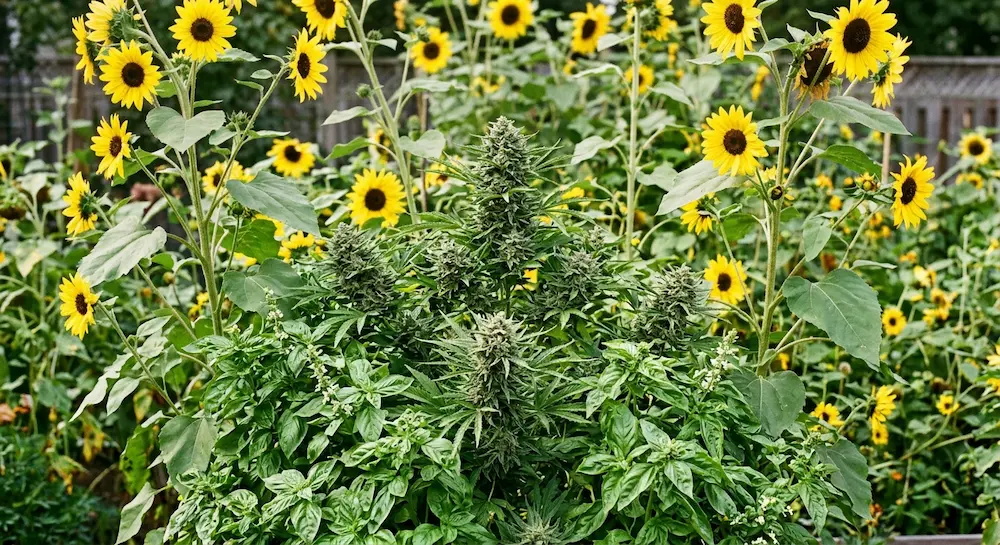
Maintaining privacy is essential when cultivating cannabis outdoors, particularly in urban, suburban, or shared garden environments. Utilizing tall, bushy, or fragrant companion plants hides your crop from view while neutralizing telltale odors.
Sunflowers (Helianthus annuus)
Sunflowers serve as effective visual camouflage for outdoor crops. Their towering stature, sturdy stalks, and large leaves visually disrupt the distinctive silhouette of cannabis plants.
- Stealth Mechanism: Giant sunflower varieties (growing 8–12 feet tall) form a dense living wall that screens cannabis foliage from neighboring lines of sight.
- Bonus Benefit: Sunflowers act as a trap crop, drawing aphids and stink bugs away from cannabis, while heavy pollen heads attract pollinators like honeybees and ladybugs.
- Garden Placement: Plant a dense line of sunflowers along the southern or eastern edges of your grow area. Space them closely enough to form an opaque screen without blocking direct overhead light during peak afternoon hours.
Sweet Basil (Ocimum basilicum)
As cannabis plants enter the flowering phase, trichome development releases strong aromatic terpenes (such as myrcene, limonene, and pinene). Sweet basil acts as an effective scent-masking companion.
- Stealth Mechanism: Basil leaves produce strong essential oils rich in eugenol and linalool. When warmed by sunlight or brushed by breezes, basil releases a rich herbaceous aroma that helps mask surrounding cannabis odors.
- Bonus Benefit: Basil leaves generate small amounts of airborne terpenes that help deter thrips, hornworms, and flies.
- Garden Placement: Interplant sweet basil directly alongside cannabis stalks—they share similar soil, moisture, and intense sunlight preferences.
Lavender (Lavandula angustifolia)
Lavender provides dual benefits, contributing both visual blending and aroma masking.
- Stealth Mechanism: Purple flower spires and silver-green foliage add color and texture variety to garden beds, drawing attention away from cannabis leaves. Its floral aroma blends with sweet or citrusy terpene profiles.
- Bonus Benefit: High concentrations of linalool repel fleas, ticks, mosquitoes, and moths while attracting beneficial pollinators.
- Garden Placement: Position perennial lavender along garden perimeters, pathways, or near outdoor seating areas.
Trap Crops & Predator Attractors: Biological Control
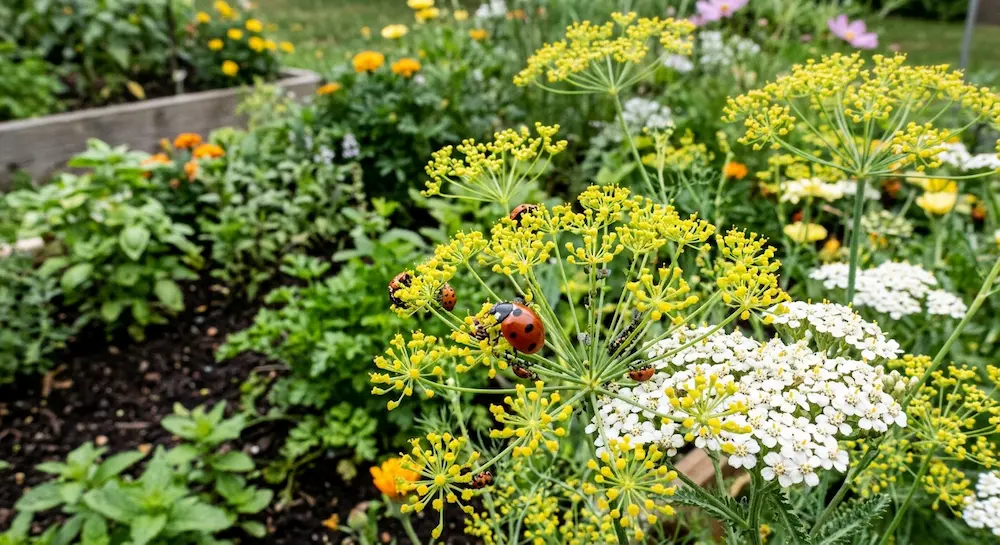
Rather than relying purely on repellents, successful organic pest control incorporates trap crops (plants grown to attract pests away from main crops) and predator-attracting flora (plants that harbor beneficial insects).
| Companion Plant | Function / Role | Target Pests Controlled | Primary Beneficiaries |
|---|---|---|---|
| Dill (Anethum graveolens) | Beneficial Attractor | Spider mites, caterpillars | Parasitic wasps, hoverflies, ladybugs |
| Yarrow (Achillea millefolium) | Predator Habitat | Aphids, thrips, leafhoppers | Predatory mites, lacewings |
| Nasturtium (Tropaeolum) | Trap Crop | Whiteflies, squash bugs, aphids | Draws pests away from main foliage |
| Sweet Alyssum (Lobularia maritima) | Groundcover / Nectar Source | Soft-bodied pests | Parasitic mini-wasps, syrphid flies |
Dill & Yarrow
- Dill: Produces small umbrella-shaped flower clusters (umbels) rich in nectar, attracting beneficial predatory insects like ladybugs, hoverflies, and parasitic wasps. Parasitic wasps deposit eggs inside harmful caterpillars, providing targeted biological pest control.
- Yarrow: Forms a dense ground cover that harbors predatory mites (Phytoseiidae), which feed on destructive two-spotted spider mites.
Nasturtium as a Trap Crop
Nasturtium functions as an effective biological diversion. Aphids prefer its tender stems over cannabis leaves. Once nasturtiums become populated with pests, gardeners can prune away infested sections or allow resident ladybugs to feed on them, isolating pest activity away from flower sites.
Soil Enhancers and Cover Crops
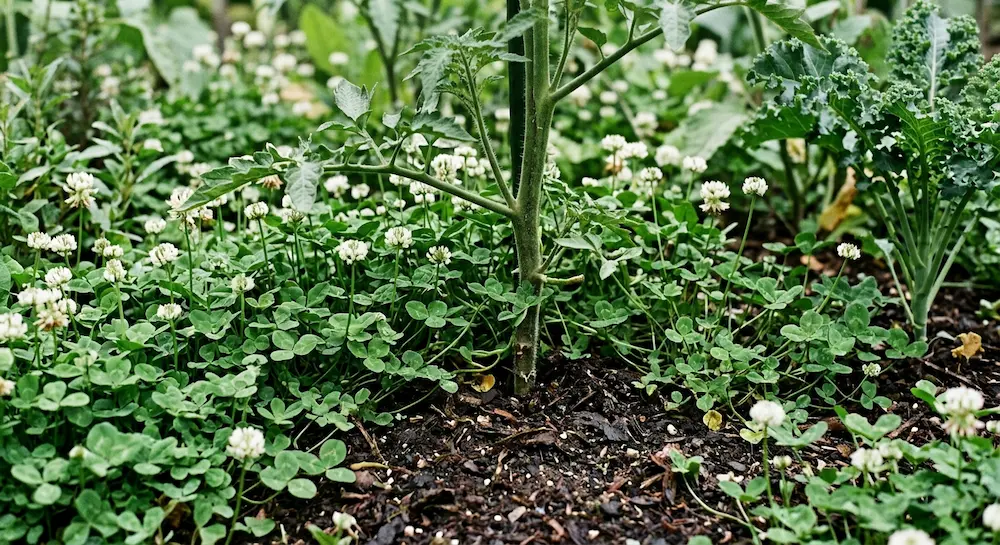
Protecting outdoor cannabis involves optimizing root zone health alongside above-ground care. Living mulches and cover crops enhance soil structure, regulate temperatures, and fix essential nutrients.
White Dutch Clover (Trifolium repens)
White clover acts as a living mulch across garden beds.
- Nitrogen Fixation: Working symbiotically with soil bacteria (Rhizobium), clover absorbs atmospheric nitrogen and converts it into bioavailable soil nutrients.
- Moisture Retention: A dense green carpet shields topsoil from intense sun exposure, reducing moisture evaporation and keeping root zones cooler during summer heat waves.
- Soil Microstructure: Root systems loosen compacted soil, improving drainage and oxygen availability for neighboring roots.
Chamomile (Matricaria recutita)
Chamomile serves as a accumulation plant, absorbing key minerals like calcium, potassium, and sulfur from deeper soil layers. When pruned or left to decompose in autumn, chamomile recycles these essential nutrients back into the topsoil, conditioning it for future planting cycles.
Strategic Layout: Designing a Stealth Garden Layout
To maximize privacy, pest protection, and light access, position companion species strategically based on plant height and growth habits:
- Outer Perimeter (North/East/West boundaries): Plant tall camouflage species such as Sunflowers or Sweet Corn to form a dense visual barrier without blocking critical southern sun exposure.
- Mid-Layer (Interplanted 1–3 feet from stalks): Alternate strong-scented aromatic herbs like Sweet Basil, Peppermint (potted), and Lavender.
- Base & Soil Layer (Direct groundcover): Sow White Clover, Marigolds, and Sweet Alyssum directly around root bases to suppress weeds, retain moisture, and protect soil microbiology.
Key Takeaways for Organic Outdoor Cultivation
- Combine Strategies: Use visual barriers (sunflowers) alongside aromatic masks (basil, lavender) and active repellents (marigolds) for comprehensive protection.
- Protect Root Zones: Use living ground cover like white clover to stabilize soil moisture and lower root temperatures.
- Avoid Invasive Species: Always grow spreading species like mint in isolated pots to prevent root competition with main garden crops.
- Embrace Polyculture: A diverse plant ecosystem creates natural balance, lowering pest pressure and reducing reliance on synthetic inputs.